







Business Continuity & Disaster Recovery Services: Keeping Operations Running Without Disruption
Unexpected disruptions are no longer rare events. From system outages and operational failures to natural disasters and large-scale emergencies, businesses today must be prepared to continue operating under any condition. The difference between organizations that survive disruption and those that struggle often comes down to one thing how well they are prepared to respond and recover.
Many companies believe they are ready because they have backup plans or written procedures. However, when disruption actually occurs, these static plans often fail due to lack of coordination, limited visibility, and slow execution. This is where business continuity and disaster recovery services become essential. They transform traditional planning into structured, real-time operational systems that ensure continuity, control, and resilience.
Understanding Business Continuity in Modern Operations
Business continuity is not just about having a backup or contingency plan. It is about ensuring that critical operations continue without interruption, even when systems or environments fail.
Modern continuity services focus on identifying essential business functions and building systems that support them during disruptions. This includes ensuring that teams know their roles, resources are available, and workflows can continue seamlessly.
Instead of relying on documents that may or may not be followed during a crisis, continuity systems provide live execution frameworks that guide teams step by step.
Why Traditional Disaster Recovery Approaches Fall Short
Traditional disaster recovery often focuses only on restoring systems after failure. While recovery is important, it does not address the challenges that occur during the disruption itself.
Organizations often face:
- Delays in response due to unclear responsibilities
- Lack of real-time updates from teams
- Difficulty coordinating across departments
- Inconsistent communication
These issues can significantly increase downtime and operational impact.
Business continuity and disaster recovery services take a broader approach. They not only focus on recovery but also ensure that operations continue during the disruption, minimizing downtime and maintaining control.
Strategic Continuity Planning Services
A strong continuity strategy begins with proper planning. This involves analyzing the organization’s operations, identifying vulnerabilities, and defining response strategies for different scenarios.
Continuity planning services help businesses:
- Identify critical processes and dependencies
- Define response actions for various risk scenarios
- Assign roles and responsibilities across teams
- Create structured workflows for execution
These plans are then converted into actionable systems that can be activated instantly when needed.
The goal is to remove uncertainty. When disruption occurs, teams should not be figuring out what to do—they should be following a clear, structured process.
Disaster Recovery System Design and Execution
Recovery is a critical part of continuity. However, without a structured system, recovery efforts can become chaotic and inefficient.
Disaster recovery services focus on building systems that ensure smooth and controlled restoration of operations. This includes designing workflows for system recovery, data restoration, and operational restart.
Instead of reacting to failures, organizations can execute predefined recovery processes that are optimized for speed and efficiency.
This reduces downtime and ensures that operations return to normal as quickly as possible.
Real-Time Incident Response and Coordination
During a disruption, time is one of the most critical factors. Delayed response can lead to increased losses and operational challenges.
Continuity services provide systems that enable real-time incident tracking and response coordination. Teams can log incidents, assign tasks, and monitor progress as events unfold.
This creates a centralized environment where all activities are visible and manageable. Decision-makers can access real-time information and respond quickly.
By eliminating delays and improving coordination, organizations can manage disruptions more effectively.
Resource Visibility and Allocation
In any crisis situation, managing resources efficiently is essential. Organizations need to know what resources are available, where they are located, and how they are being used.
Business continuity services provide real-time resource management capabilities. This ensures that personnel, equipment, and supplies are allocated effectively.
With full visibility, organizations can avoid duplication, reduce delays, and ensure that critical tasks are supported properly.
Efficient resource management plays a key role in maintaining operations during disruptions.
Communication and Information Flow
Communication breakdown is one of the most common causes of operational failure during disruptions. When teams do not have access to consistent and timely information, confusion and delays occur.
Continuity services implement structured communication systems that ensure information flows smoothly across the organization.
Updates are shared in real time, and all stakeholders have access to the same information. This reduces uncertainty and improves coordination.
Clear communication also helps maintain confidence among teams, allowing them to focus on execution rather than uncertainty.
Reporting, Documentation, and Compliance
Accurate reporting is essential during and after disruptions. It helps organizations understand what happened, evaluate performance, and improve future responses.
Continuity services include systems for real-time reporting and standardized documentation. This ensures that all actions are recorded and can be reviewed later.
Organizations can generate reports quickly, maintain compliance with regulations, and use insights to strengthen their processes.
This structured approach to reporting improves transparency and accountability.
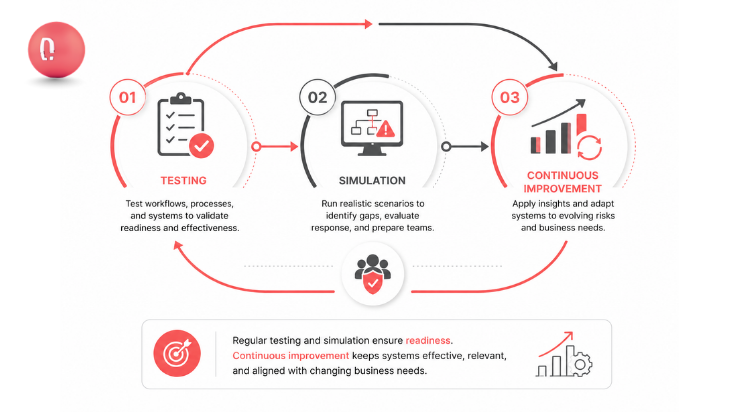
Testing, Simulation, and Continuous Improvement
A continuity plan is only effective if it works in real scenarios. Testing and simulation services play a critical role in ensuring readiness.
Organizations can run simulated scenarios to test their workflows, identify gaps, and improve their systems. Regular testing builds confidence and ensures that teams are prepared for actual disruptions.
Continuous improvement is a key part of these services. Systems are updated based on insights and changing business needs, ensuring that they remain effective over time.
Customization Based on Business Needs
Every organization has unique operations and risks. Business continuity services are designed to be flexible and adaptable.
Custom workflows can be created based on specific processes, industry requirements, and organizational structures. This ensures that continuity systems are practical and aligned with real-world operations.
Instead of forcing businesses to adapt to rigid systems, these services adapt to the business.
Building Long-Term Operational Resilience
Business continuity is not just about surviving disruptions—it is about building resilience.
Organizations that invest in continuity services are better equipped to handle uncertainty. They can respond quickly, recover efficiently, and maintain operations under challenging conditions.
Resilience becomes a strategic advantage, enabling businesses to operate confidently in a rapidly changing environment.
Strengthen Your Operations for the Unexpected
Disruptions are inevitable, but their impact can be controlled. The key lies in having systems that are prepared, responsive, and efficient.
Business continuity and disaster recovery services provide the structure and tools needed to manage disruptions effectively. They transform uncertainty into controlled execution and ensure that operations continue without major interruptions.
If your organization is looking to reduce risk, improve response capabilities, and build long-term resilience, explore how DLAN.ai can help you design and implement systems that keep your operations running—no matter what happens.
