







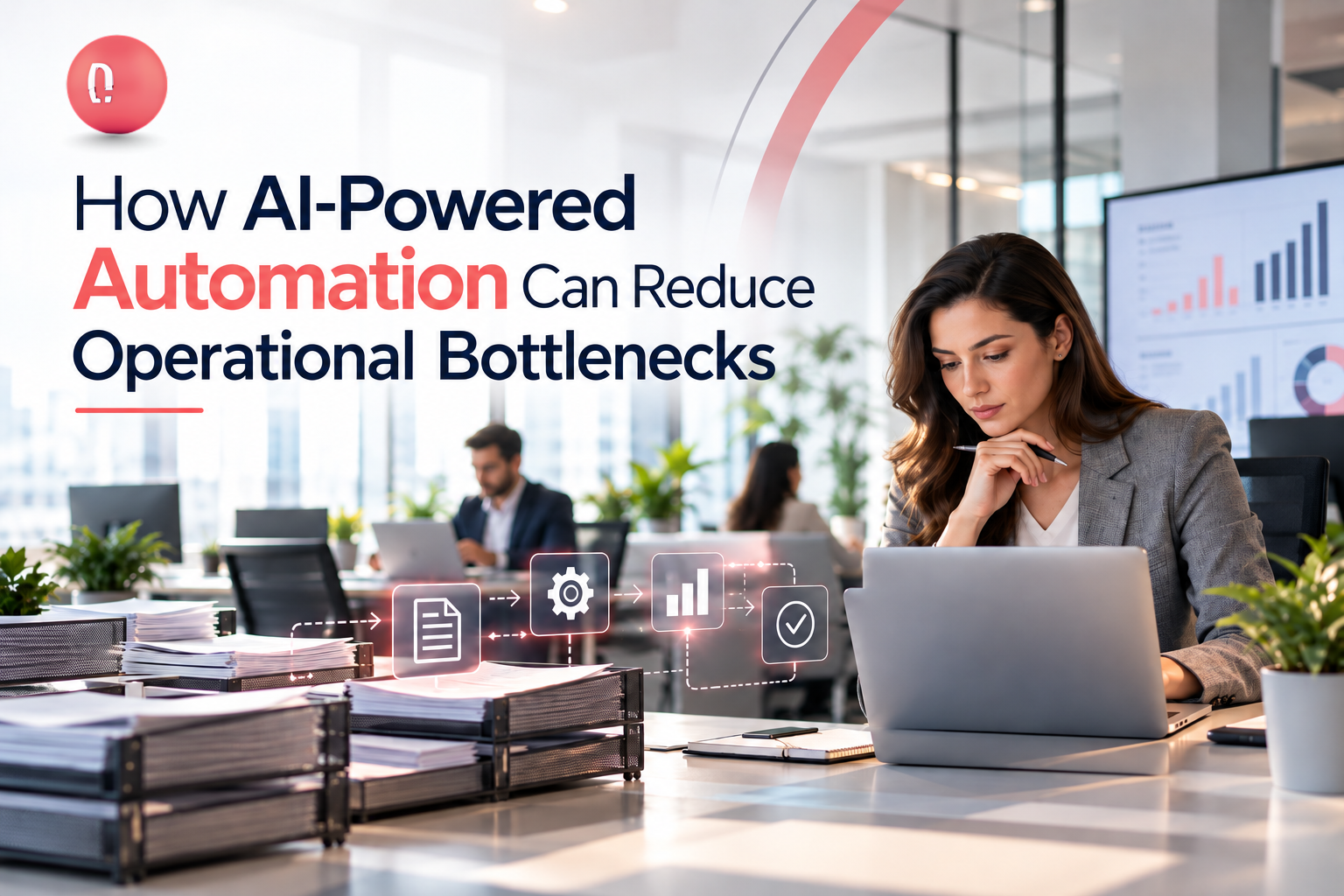
How AI-Powered Automation Can Reduce Operational Bottlenecks
Businesses depend on people, processes, applications, and infrastructure working together. When one part of that system slows down, the impact can spread across the organization.
A delayed approval can hold up a project. Manual data entry can slow down reporting. Repetitive customer requests can consume employee time. Outdated processes can make it difficult for teams to respond quickly when demand increases.
These problems are often called operational bottlenecks.
Artificial intelligence and automation are changing how organizations approach these challenges. Instead of relying entirely on manual processes, businesses can use AI-powered automation to handle repetitive tasks, identify patterns, route information, and support faster decision-making.
The goal is not simply to automate everything. Effective automation focuses on the areas where technology can remove unnecessary delays while allowing employees to concentrate on tasks that require human judgment.
Businesses can begin this process with professional IT consultancy to understand where technology can create measurable operational improvements.
What Is AI-Powered Automation?
AI-powered automation combines traditional automation with artificial intelligence.
Traditional automation follows predefined rules. For example, a system might automatically send an email when a form is submitted.
AI-powered automation can go further. It can process information, identify patterns, classify requests, generate responses, or support decisions based on available data.
This makes it useful for business processes that involve large amounts of information or changing conditions.
For example, an organization could use AI to classify incoming requests before automatically sending them to the appropriate department.
The employee still manages the process, but the repetitive first step is handled by technology.
Why Do Operational Bottlenecks Develop?
Operational bottlenecks can appear for many reasons.
A business may have:
- Too many manual approval steps
- Repetitive data entry
- Disconnected applications
- Slow reporting processes
- Limited visibility into operations
- High volumes of customer requests
- Outdated workflows
- Complex communication processes
- Systems that do not scale with demand
As a business grows, these problems can become more noticeable.
A process that works for 20 employees may become difficult to manage when the organization has hundreds or thousands of users.
This is where scalable software solutions can help organizations rethink how applications support everyday operations.
Identify the Bottleneck Before Automating It
One of the most important steps in automation is understanding the existing process.
Businesses should not automate a process simply because it is currently manual.
First, teams should identify:
- Where delays occur
- How often they occur
- Which employees are affected
- What information is required
- Which applications are involved
- What decisions are currently made manually
- What the process costs in time and resources
This creates a clearer picture of the actual problem.
Automation can then be designed around the bottleneck instead of simply adding another technology layer.
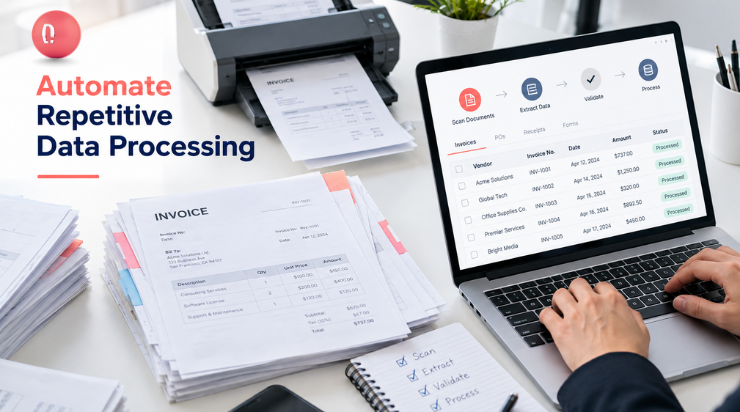
Automate Repetitive Data Processing
Data processing is one area where AI-powered automation can provide significant support.
Employees may spend hours collecting information from emails, documents, spreadsheets, forms, and different business systems.
AI can help classify and organize information before it reaches the next stage of a workflow.
For example, an organization receiving hundreds of service requests could use automation to categorize incoming requests based on their content.
The relevant team can then receive the request without manually sorting every submission.
This can reduce repetitive work and allow employees to focus on more valuable activities.
Improve Customer Service Workflows
Customer-facing operations often experience bottlenecks when request volumes increase.
AI-powered systems can assist with tasks such as:
- Request classification
- Frequently asked questions
- Appointment scheduling
- Initial information collection
- Ticket routing
- Customer communication
- Follow-up reminders
This does not mean every customer interaction should be handled by AI.
Instead, automation can manage predictable tasks while complex cases are transferred to employees.
Organizations can combine these capabilities with broader managed services to maintain and monitor technology environments.
Reduce Approval Delays
Approval processes can become bottlenecks when employees need to manually review large numbers of routine requests.
AI-powered automation can help identify routine cases and route them according to predefined business rules.
For example, a system could automatically send standard requests to the appropriate approval workflow while flagging unusual cases for human review.
This creates a balance between automation and human oversight.
The important point is that AI should support organizational controls rather than bypass them.
Connect Different Business Systems
Another common bottleneck occurs when employees have to move information manually between applications.
A business might use separate systems for:
- Customer management
- Finance
- Human resources
- Inventory
- Sales
- Marketing
- Operations
When these systems cannot communicate effectively, employees may become the connection between them.
That creates additional work and increases the possibility of errors.
Modern cloud services and software architectures can help businesses build more connected digital environments.
Use AI to Support Decision-Making
Automation is not limited to repetitive tasks.
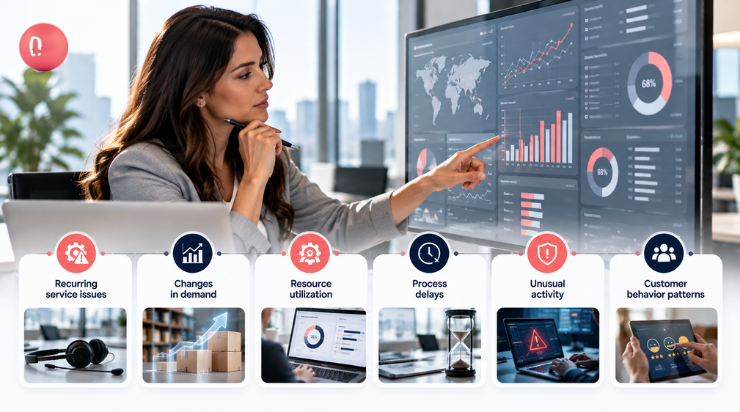
AI can also help organizations identify patterns in operational data.
For example, businesses may use analytics to identify:
- Recurring service issues
- Changes in demand
- Resource utilization
- Process delays
- Unusual activity
- Customer behavior patterns
These insights can help management investigate problems before they become larger operational issues.
AI should support decision-making rather than replace appropriate human review.
Improve IT Operations
Technology itself can become a bottleneck when IT teams spend most of their time responding to recurring issues.
Automation can help with certain IT tasks, including monitoring, alerts, routine maintenance, and incident workflows.
This can allow technical teams to spend more time on infrastructure improvements and strategic projects.
Organizations with complex technology environments can also consider cybersecurity services as part of their automation strategy.
Automation should always be designed with security in mind.
Security Must Be Part of AI Automation
AI-powered automation often interacts with business information.
That means security cannot be treated as an afterthought.
Organizations should consider:
- Who can access automated systems?
- What information can AI process?
- Where is information stored?
- Which systems can the automation access?
- How are actions recorded?
- How are permissions managed?
- What happens when an automated process fails?
A strong security strategy can help businesses manage these risks while introducing new automation capabilities.
Automate Without Removing Human Oversight
Not every business decision should be automated.
Some processes involve financial decisions, sensitive information, compliance requirements, or customer issues that require human judgment.
A practical approach is to divide processes into three areas:
Fully automated: Routine, low-risk tasks.
AI-assisted: Tasks where AI provides recommendations or classifications but employees make the final decision.
Human-led: Complex or sensitive decisions requiring professional judgment.
This model allows organizations to gain efficiency without losing necessary human control.
Measure the Results
Automation should produce measurable improvements.
Businesses can track metrics such as:
- Processing time
- Employee workload
- Error rates
- Customer response time
- Number of manual steps
- Operational costs
- System availability
- Request resolution time
These measurements help determine whether automation is actually solving the original bottleneck.
They also provide useful information for improving the next stage of the technology roadmap.
AI Automation Across Different Industries
The potential applications of AI-powered automation differ by industry.
Healthcare organizations can explore technology that supports connected healthcare operations through DLAN’s healthcare solutions.
Financial institutions can apply automation to operational workflows, reporting, customer interactions, and technology environments through industry-focused banking solutions.
Educational organizations can also use digital technologies to improve learning and administrative processes through education solutions.
The technology should always be adapted to the organization’s specific processes and requirements.
Build an Automation Roadmap
Businesses should avoid implementing AI automation as a collection of disconnected experiments.
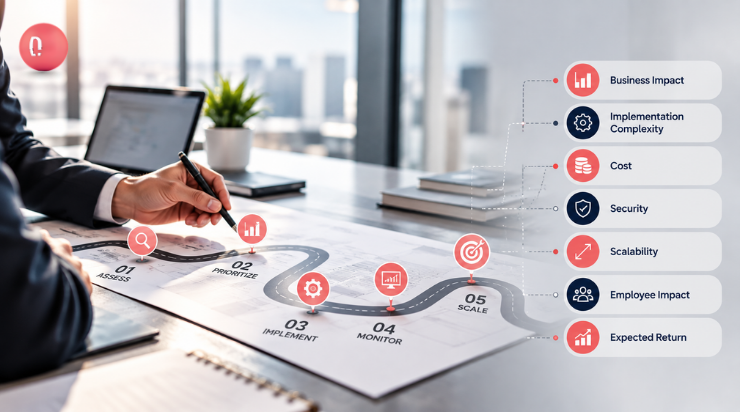
A better approach is to create an automation roadmap.
Start by identifying high-impact bottlenecks. Then evaluate the available data, applications, infrastructure, security requirements, and expected business outcomes.
From there, organizations can prioritize automation projects based on factors such as:
- Business impact
- Implementation complexity
- Cost
- Security
- Scalability
- Employee impact
- Expected return
For larger organizations, enterprise solutions can help bring technology requirements together across multiple areas of the business.
The Role of Infrastructure
AI automation also depends on reliable infrastructure.
Applications need appropriate computing resources, connectivity, storage, and security.
For organizations operating large technology environments, data center consultancy can support infrastructure planning and development.
Reliable telecommunications can also be important when automated systems depend on connected locations and devices. DLAN’s telecommunications services cover technology infrastructure and connectivity requirements.
Final Thoughts
AI-powered automation can help businesses reduce operational bottlenecks by handling repetitive work, connecting processes, improving information flow, and supporting faster decisions.
However, successful automation is not simply about introducing AI.
Businesses need to understand their processes first, identify the right bottlenecks, establish security controls, maintain human oversight, and measure the results.
With the right strategy, AI-powered automation can become part of a broader digital transformation program that helps organizations create more responsive, scalable, and efficient operations.