







AI Governance and Compliance for Secure Business Growth
Artificial intelligence is no longer just a future technology. It is already becoming part of daily business operations. Companies are using AI for customer support, data analysis, automation, marketing, cybersecurity, recruitment, reporting, decision-making, and internal productivity.
But as AI adoption grows, so does the risk.
Many businesses are using AI tools without clear policies, proper access control, data protection rules, or compliance oversight. Employees may enter sensitive business data into public AI platforms. Teams may use AI-generated content without review. Companies may depend on automated decisions without understanding how those decisions are made. Vendors may also add AI features into software without giving full visibility into how data is processed.
This is why AI governance and compliance have become critical for modern businesses.
AI governance is the process of managing how artificial intelligence is used across an organization. It helps businesses define rules, reduce risks, protect data, improve transparency, and use AI responsibly. AI compliance ensures that AI systems follow legal, ethical, security, and industry requirements.
For growing companies, AI governance is not only about avoiding risk. It is about building trust, improving security, and making sure AI supports business growth in a safe and controlled way.
What Is AI Governance?
AI governance is a structured approach for managing artificial intelligence across the business. It defines how AI tools are selected, used, monitored, secured, and reviewed.
A good AI governance strategy answers important questions such as:
- Which AI tools are approved for business use?
- What type of data can employees enter into AI platforms?
- Who is responsible for reviewing AI-generated decisions?
- How are AI risks identified and managed?
- How does the company protect sensitive data?
- How are AI vendors evaluated?
- How does the business stay compliant with regulations?
- How are AI outputs checked for accuracy, bias, and security?
Without governance, AI adoption can become uncontrolled. Different teams may start using different tools without IT, legal, security, or leadership oversight. This creates what many experts call “shadow AI,” where employees use AI systems without official approval or visibility.
Shadow AI can expose sensitive data, increase compliance risk, and create security gaps. That is why businesses need clear AI policies before scaling AI across departments.
What Is AI Compliance?
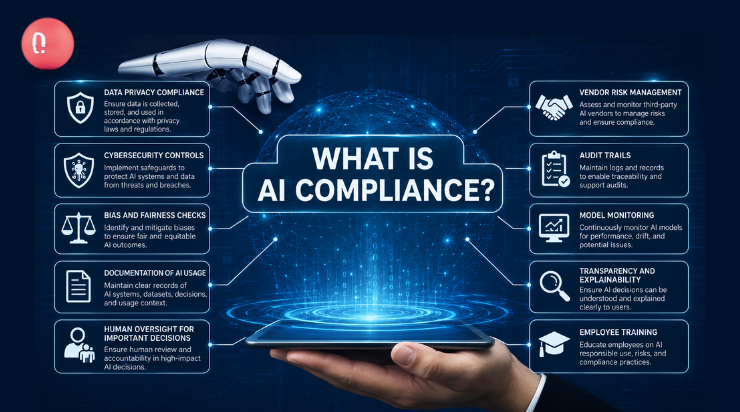
AI compliance means making sure that AI systems follow relevant laws, regulations, industry standards, internal policies, and ethical requirements.
AI compliance may include:
- Data privacy compliance
- Cybersecurity controls
- Bias and fairness checks
- Documentation of AI usage
- Human oversight for important decisions
- Vendor risk management
- Audit trails
- Model monitoring
- Transparency and explainability
- Employee training
Different industries may have different requirements. A healthcare company using AI must think about patient data. A financial services company must think about automated decisions and fraud detection. A recruitment company must think about fairness and bias. A government contractor must think about security, accountability, and audit readiness.
This is why AI compliance cannot be treated as a simple checklist. It must be built into the company’s governance, cybersecurity, data management, and risk strategy.
Why AI Governance Matters Now
AI is moving faster than traditional business policies. Many companies are already using AI before they have proper governance in place.
This creates several risks.
First, there is the risk of data exposure. Employees may accidentally share confidential information, customer data, financial records, source code, legal documents, or internal business plans with AI tools.
Second, there is the risk of inaccurate outputs. AI systems can produce wrong, outdated, biased, or incomplete information. If teams use these outputs without review, the business may make poor decisions.
Third, there is the risk of compliance failure. AI-related regulations and standards are developing quickly. Businesses that do not prepare early may face future legal, financial, or reputational problems.
Fourth, there is the risk of cyberattacks. AI systems can be targeted through prompt injection, data poisoning, model manipulation, credential misuse, and unauthorized access.
NIST’s AI Risk Management Framework focuses on helping organizations better manage AI risks across individuals, organizations, and society. This shows that AI risk is not only a technical issue. It is also a governance, trust, and business management issue.
The Link Between AI Governance and Cybersecurity
AI governance and cybersecurity are closely connected. Any business using AI must think about how AI tools access, process, store, and generate data.
For example, if employees use AI chatbots to summarize customer documents, the business must know whether that data is being stored, reused, or exposed. If developers use AI coding tools, the company must check whether sensitive code or credentials are being shared. If AI is connected to business applications, the company must control what actions the AI can perform.
Cybersecurity teams must now protect not only networks, endpoints, and cloud systems, but also AI workflows, prompts, datasets, models, and third-party AI tools.
AI security should include:
- Strong identity and access management
- Data classification
- Approved AI tool lists
- Secure API access
- Monitoring of AI usage
- Vendor security reviews
- Protection against prompt injection
- Human approval for high-risk decisions
- Logging and audit trails
- Regular risk assessments
A strong AI governance framework helps security teams understand where AI is being used and what risks need to be controlled.
The Role of Data Governance in AI
AI depends on data. If the data is sensitive, inaccurate, biased, outdated, or poorly protected, the AI output can create serious problems.
This is why data governance is a key part of AI governance.
Data governance defines how data is collected, stored, classified, accessed, protected, and used. Before a company scales AI, it must understand what data it has, where it lives, who can access it, and how it should be protected.
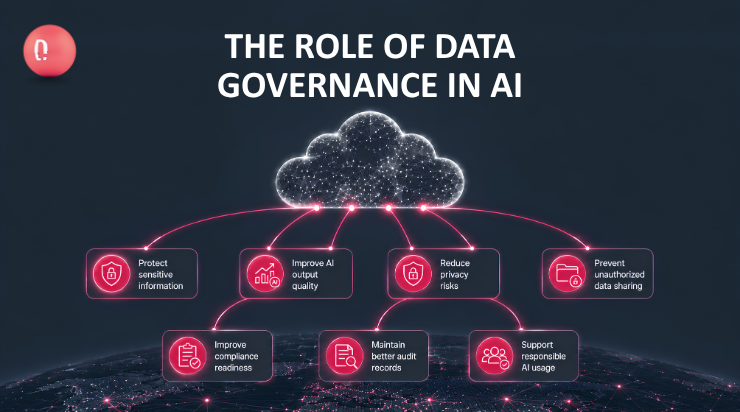
Good data governance helps businesses:
- Protect sensitive information
- Improve AI output quality
- Reduce privacy risks
- Prevent unauthorized data sharing
- Improve compliance readiness
- Maintain better audit records
- Support responsible AI usage
Without strong data governance, AI systems may create more risk than value.
AI Governance and GRC
Governance, Risk, and Compliance, also known as GRC, plays a major role in responsible AI adoption.
AI governance should not be handled separately from the company’s broader risk management strategy. It should be connected with cybersecurity policies, compliance programs, internal controls, vendor management, and business continuity planning.
A strong AI GRC approach includes:
- AI policy development
- AI risk assessments
- Compliance gap analysis
- Role-based accountability
- Vendor AI reviews
- Employee training
- Incident response planning
- Internal reporting
- Continuous monitoring
This helps leadership understand how AI is being used, what risks exist, and what controls are needed.
For businesses, the goal is not to stop AI adoption. The goal is to make AI adoption safer, smarter, and more aligned with business goals.
Common AI Risks Businesses Should Manage
AI creates many opportunities, but it also brings risks that companies must manage carefully.
1. Data Privacy Risk
Employees may enter confidential or personal data into AI tools without knowing how that data will be stored or used.
2. Security Risk
AI systems can be attacked, manipulated, or connected to sensitive systems without proper controls.
3. Bias Risk
AI tools can produce unfair or biased outputs if the training data or system design is flawed.
4. Accuracy Risk
AI-generated information may sound confident but still be incorrect. This can lead to poor decisions.
5. Compliance Risk
Businesses may fail to meet legal, regulatory, or industry requirements if AI is used without oversight.
6. Vendor Risk
Third-party AI tools may process business data in ways the company does not fully understand.
7. Reputation Risk
Wrong or unethical AI usage can damage customer trust and brand reputation.
8. Operational Risk
Overdependence on AI without human review can create errors in workflows, reporting, customer service, and decision-making.
How Businesses Can Build an AI Governance Strategy
Building AI governance does not mean creating unnecessary complexity. It means creating clear, practical rules that help the business use AI safely.
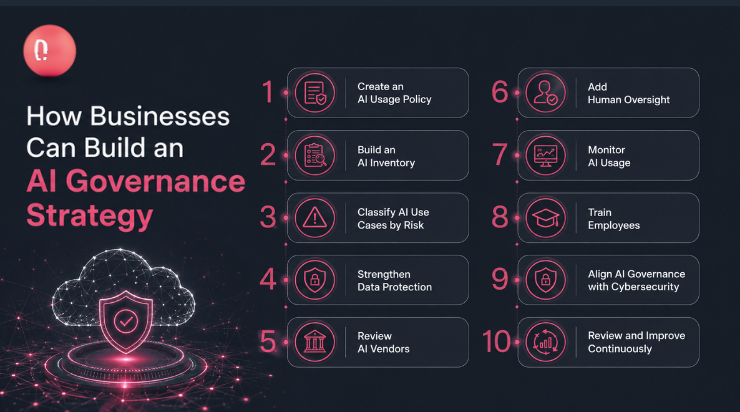
1. Create an AI Usage Policy
The first step is to define what AI tools employees can use, what data they can share, and what use cases require approval.
This policy should be simple, clear, and easy for employees to follow.
2. Build an AI Inventory
Businesses should create a list of all AI tools, platforms, vendors, and internal systems being used across the organization.
This helps leadership and IT teams understand where AI already exists.
3. Classify AI Use Cases by Risk
Not every AI use case has the same risk level. Using AI to draft internal notes is very different from using AI to make hiring, financial, medical, or security decisions.
High-risk use cases should require stronger controls and human oversight.
4. Strengthen Data Protection
Before scaling AI, businesses should classify sensitive data, limit access, and define what information can or cannot be used in AI systems.
5. Review AI Vendors
Companies should check how third-party AI vendors store data, process information, manage security, and support compliance.
6. Add Human Oversight
AI should support decisions, not replace accountability. Important decisions should always involve human review.
7. Monitor AI Usage
Businesses should monitor how AI tools are being used, especially when they connect with sensitive data or business-critical systems.
8. Train Employees
Employees need clear guidance on safe AI usage. Training should explain data privacy, security risks, accuracy issues, and responsible AI behavior.
9. Align AI Governance with Cybersecurity
AI governance should be connected with identity management, access control, incident response, cloud security, and compliance programs.
10. Review and Improve Continuously
AI governance is not a one-time project. It should be reviewed regularly as tools, risks, and regulations change.
Benefits of AI Governance and Compliance
A strong AI governance program gives businesses more confidence when adopting AI.
Better Data Protection
Clear rules reduce the chance of sensitive data being shared with unapproved AI tools.
Stronger Compliance Readiness
Good documentation, policies, and controls help businesses prepare for audits and regulatory expectations.
Improved Trust
Customers, partners, and employees are more likely to trust a business that uses AI responsibly.
Reduced Security Risk
AI governance helps security teams understand and control AI-related risks.
Smarter AI Adoption
Businesses can use AI more effectively when they know where it adds value and where it creates risk.
Better Decision-Making
Human oversight and review processes help prevent blind trust in inaccurate AI outputs.
Stronger Vendor Management
AI governance helps businesses evaluate vendors before giving them access to sensitive systems or data.
How DLAN Can Help Businesses with AI Governance
DLAN helps businesses simplify IT, strengthen cybersecurity, and build scalable technology foundations for long-term growth. Its service direction includes IT consulting, cybersecurity solutions, risk management, cloud, network, and infrastructure services.
With AI governance and compliance support, DLAN can help organizations create a safer and more structured approach to AI adoption.
DLAN can support businesses with:
- AI readiness assessments
- AI policy development
- Cybersecurity risk assessments
- Data governance planning
- Cloud and infrastructure security
- Vendor risk review
- Access control strategy
- Compliance gap analysis
- Managed security monitoring
- GRC consulting
- Employee AI usage guidelines
- Secure digital transformation planning
This gives businesses the confidence to use AI without exposing sensitive data, increasing compliance risk, or weakening cybersecurity.
Why Businesses Should Not Wait
Many companies are already using AI, even if leadership has not officially approved it. Waiting too long to create governance can make the risk harder to control.
The best time to build AI governance is before AI becomes deeply embedded in every department.
Businesses that act early can create better policies, train employees, protect data, reduce risk, and build stronger trust with customers and partners.
AI governance does not slow innovation. It protects innovation.
When businesses use AI with the right controls, they can move faster with more confidence.
Conclusion
AI is changing how businesses work, but it also brings new risks around data privacy, cybersecurity, compliance, accuracy, vendor management, and trust.
This is why AI governance and compliance are becoming essential for modern organizations. Businesses need clear policies, strong security controls, proper data governance, employee training, and ongoing monitoring before scaling AI across departments.
With the right strategy, AI can become a powerful business advantage instead of a hidden risk.
DLAN helps businesses build secure, scalable, and future-ready technology environments through cybersecurity, IT consulting, managed services, cloud solutions, and governance risk and compliance support. By creating a structured AI governance strategy, DLAN can help organizations adopt AI responsibly, protect sensitive data, and grow with confidence.
FAQs
What is AI governance?
AI governance is the process of creating rules, policies, controls, and accountability for how artificial intelligence is used across a business.
Why is AI compliance important?
AI compliance helps businesses follow legal, ethical, security, and industry requirements when using AI tools or systems.
What are the biggest AI risks for businesses?
The biggest risks include data exposure, inaccurate outputs, bias, cyberattacks, vendor risk, compliance failure, and lack of human oversight.
How does AI governance support cybersecurity?
AI governance helps cybersecurity teams understand where AI is being used, what data is involved, who has access, and what controls are needed.
Do small and mid-sized businesses need AI governance?
Yes. Any business using AI tools should have basic governance policies to protect data, reduce risk, and guide employees.
How can DLAN help with AI governance?
DLAN can help businesses assess AI risks, create AI usage policies, strengthen cybersecurity controls, improve data governance, review vendors, and align AI adoption with GRC requirements.
