






SASE and Zero Trust: Why Businesses Must Move Beyond Traditional VPN Security
Business networks have changed. Employees are no longer working from one office, using one network, and accessing one internal system. Today, businesses use cloud applications, remote teams, mobile devices, SaaS platforms, third-party tools, and hybrid infrastructure.
This change has made traditional network security weaker.
For many years, companies used VPNs to give employees remote access to business systems. But VPNs were designed for a different time. They often give broad access to internal networks, create performance issues, and become difficult to manage when users, devices, and cloud applications increase.
This is why more businesses are now moving toward SASE and Zero Trust.
SASE, also known as Secure Access Service Edge, brings networking and security together in a cloud-based model. Zero Trust follows a simple but powerful idea: never trust automatically, always verify. Together, they help businesses protect users, applications, data, and cloud systems from modern cyber threats.
For companies that want stronger security, better performance, and safer remote access, SASE and Zero Trust are no longer optional. They are becoming part of the modern security foundation.
What Is SASE?
SASE stands for Secure Access Service Edge. It is a modern security and networking model that combines network connectivity with security services in one cloud-based architecture.
Cloudflare defines SASE as a model that unifies network connectivity and network security functions onto a single cloud-based platform. Microsoft also describes SASE as a cloud-based architecture that brings WAN and network security services together into one unified platform.
In simple words, SASE helps businesses secure access to applications, users, devices, cloud systems, and branch offices without depending only on old perimeter-based security.
A SASE model can include:
- Secure web gateway
- Cloud access security broker
- Firewall as a service
- Zero Trust Network Access
- Data loss prevention
- SD-WAN
- Identity-based access control
- Threat detection
- Cloud security policies
The goal is to give users secure access from anywhere while keeping business data protected.
What Is Zero Trust?
Zero Trust is a cybersecurity strategy based on continuous verification. It does not automatically trust users, devices, or applications just because they are inside the company network.
Palo Alto Networks explains Zero Trust as a strategy that removes implicit trust and requires access control, content inspection, and traffic logging before access is granted.
This means every access request should be checked based on identity, device health, location, behavior, application sensitivity, and risk level.
Zero Trust focuses on:
- Verifying every user
- Checking every device
- Giving minimum required access
- Monitoring activity continuously
- Blocking unauthorized movement
- Protecting sensitive applications
- Reducing insider and external risks
The goal is not to make access difficult. The goal is to make access safer.
Why VPNs Are No Longer Enough
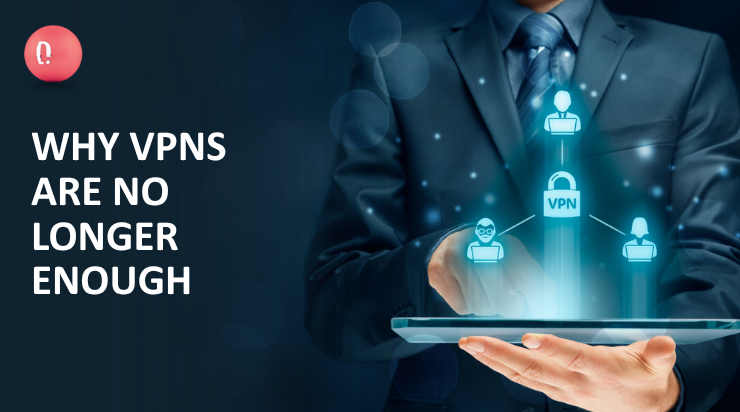
VPNs were useful when most business systems were inside company offices or private data centers. But today, business technology is more distributed.
Employees may access company systems from home, client sites, airports, mobile devices, or different countries. Applications may be hosted in public cloud, private cloud, SaaS platforms, or on-premises systems.
Traditional VPNs create several problems in this environment.
First, VPNs often give users broad access to the internal network. If a user account is compromised, an attacker may move deeper into the business environment.
Second, VPNs can become slow when many users connect at the same time. This affects productivity and user experience.
Third, VPNs are harder to manage across cloud applications, remote teams, contractors, and multiple business locations.
Fourth, VPNs do not always provide strong visibility into user behavior, device risk, or application-level access.
Zero Trust Network Access, or ZTNA, solves many of these problems by giving users access only to the specific applications and services they are approved to use. Palo Alto Networks explains that ZTNA provides secure remote access based on defined access control policies and defaults to deny instead of giving broad LAN access.
Why SASE and Zero Trust Work Better Together
SASE and Zero Trust are powerful because they solve different parts of the same security challenge.
Zero Trust defines the security principle: do not trust automatically, verify continuously.
SASE provides the architecture that helps deliver secure access across users, networks, cloud platforms, and applications.
Together, they help businesses protect modern digital environments where employees, customers, applications, and data are no longer located in one place.
For example, a company can use Zero Trust to verify user identity and limit access. SASE can then enforce those security policies through cloud-based security services, secure web access, data protection, and network controls.
This creates a stronger security model for:
- Remote workers
- Hybrid teams
- Cloud applications
- Branch offices
- SaaS platforms
- Mobile users
- Contractors and vendors
- Sensitive business data
Instead of protecting only the office network, businesses can protect every access point.
Why This Matters for Modern Businesses
Cybersecurity is no longer only about firewalls and antivirus software. Modern attacks often target identity, access, cloud applications, and user behavior.
Attackers may steal employee passwords, trick users through phishing, exploit weak remote access, or move laterally inside networks after gaining entry.
SASE and Zero Trust reduce these risks by controlling who can access what, from where, and under which conditions.
This is especially important for businesses in healthcare, banking, education, government, telecom, energy, and enterprise environments where data protection and compliance are critical.
DLAN already serves industries such as healthcare, enterprise, education, banking, government, and power sector organizations, making this topic highly relevant for the website.
Key Benefits of SASE and Zero Trust
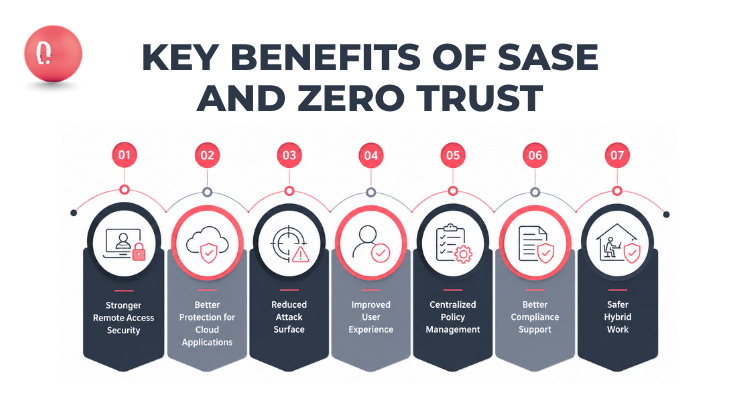
1. Stronger Remote Access Security
SASE and Zero Trust allow employees to access business applications securely without exposing the entire internal network. This reduces the risk of unauthorized access.
2. Better Protection for Cloud Applications
Modern businesses use cloud platforms every day. SASE helps protect cloud traffic, SaaS applications, and data movement with centralized security policies.
3. Reduced Attack Surface
Zero Trust limits user access to only what is needed. This reduces the number of systems an attacker can reach if one account is compromised.
4. Improved User Experience
Instead of routing all traffic through a slow VPN, SASE can connect users through cloud-based security points closer to them. This can improve speed and reliability.
5. Centralized Policy Management
Businesses can manage access, security, and network policies from one place instead of handling multiple disconnected tools.
6. Better Compliance Support
SASE and Zero Trust help businesses improve access control, traffic monitoring, logging, and data protection. These are important for compliance and audit readiness.
7. Safer Hybrid Work
Whether employees work from the office, home, or another location, businesses can apply consistent security rules.
Common Signs Your Business Needs SASE and Zero Trust
Your business may need SASE and Zero Trust if:
- Your teams still rely heavily on VPNs
- Employees work remotely or in hybrid roles
- You use many cloud or SaaS applications
- You have multiple office or branch locations
- Your IT team struggles with access control
- You lack visibility into user activity
- You handle sensitive customer or business data
- You need stronger compliance controls
- You are concerned about phishing or credential theft
- Your network security tools are disconnected
If any of these issues exist, it may be time to modernize your security architecture.
How Businesses Can Start Implementing SASE and Zero Trust
A full SASE and Zero Trust strategy does not need to happen overnight. Businesses can start step by step.
Step 1: Assess Current Network and Access Risks
Start by reviewing how users access business systems today. Identify VPN usage, cloud applications, user roles, device types, and sensitive data locations.
Step 2: Identify Critical Applications
List the most important business applications and decide which users need access to each one.
Step 3: Strengthen Identity and Access Management
Use strong authentication, role-based access, and least-privilege access policies.
Step 4: Replace Broad VPN Access with ZTNA
Move from full network access to application-specific access. This reduces risk and improves control.
Step 5: Secure Cloud and SaaS Applications
Add visibility and protection for cloud applications, file sharing, email systems, and SaaS platforms.
Step 6: Monitor User and Device Behavior
Track unusual access patterns, risky devices, failed login attempts, and suspicious activity.
Step 7: Align Security with Compliance
Connect SASE and Zero Trust with governance, risk, and compliance requirements.
Step 8: Work with a Trusted Technology Partner
Businesses need the right partner to design, implement, manage, and improve SASE and Zero Trust over time.
How DLAN Can Help
DLAN helps businesses build secure, scalable, and future-ready technology environments through cybersecurity, managed services, cloud services, telecom, IT consultancy, and GRC support. Its website positions DLAN as a technology partner focused on secure digital transformation, modern cybersecurity, reliable managed services, and scalable cloud solutions.
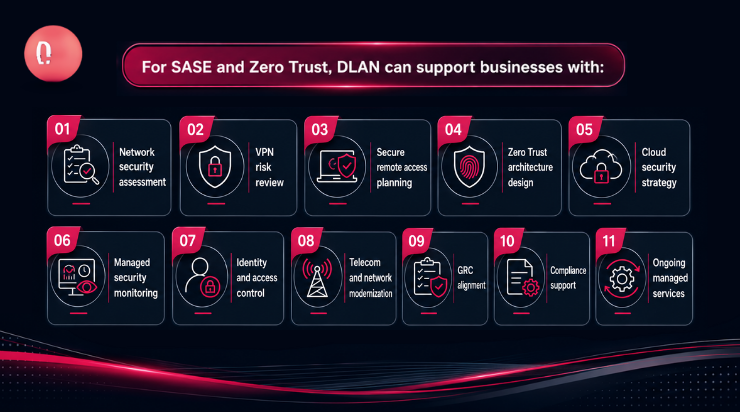
For SASE and Zero Trust, DLAN can support businesses with:
- Network security assessment
- VPN risk review
- Secure remote access planning
- Zero Trust architecture design
- Cloud security strategy
- Managed security monitoring
- Identity and access control
- Telecom and network modernization
- GRC alignment
- Compliance support
- Ongoing managed services
This makes DLAN a strong partner for companies that want to move from outdated security models to a modern, cloud-ready security framework.
Conclusion
Traditional VPN security is no longer enough for modern businesses. As teams become more distributed and applications move to the cloud, companies need a smarter way to secure access.
SASE and Zero Trust provide that foundation.
Together, they help businesses protect users, applications, cloud systems, and sensitive data with stronger access control, better visibility, and continuous verification.
For businesses that want secure growth, safer remote work, and stronger compliance readiness, now is the right time to move beyond traditional VPNs.
DLAN helps organizations modernize their cybersecurity, cloud, telecom, and managed service environments with secure, scalable, and business-focused solutions.
FAQs
What is SASE?
SASE, or Secure Access Service Edge, is a cloud-based security and networking model that combines secure access, network connectivity, and security services into one framework.
What is Zero Trust?
Zero Trust is a cybersecurity strategy that verifies every user, device, and access request instead of automatically trusting anyone inside the network.
Is SASE the same as Zero Trust?
No. Zero Trust is a security strategy, while SASE is an architecture that can help deliver Zero Trust across users, applications, cloud systems, and networks.
Why are companies moving away from VPNs?
Companies are moving away from VPNs because VPNs often provide broad network access, limited visibility, slower performance, and weaker control for cloud and remote work environments.
What is ZTNA?
ZTNA stands for Zero Trust Network Access. It gives users access only to approved applications instead of giving full access to the internal network.
How can DLAN help with SASE and Zero Trust?
DLAN can help businesses assess current risks, design secure access models, improve cloud security, support compliance, and manage modern cybersecurity environments.
