







IT Infrastructure Assessment: Find Hidden Risks Before They Disrupt Business Growth
Business technology rarely fails all at once.
Problems normally appear slowly.
A server takes longer to respond. Employees begin reporting unstable applications. Cloud costs increase. Backups become difficult to verify. Software reaches the end of its supported life. IT teams spend more time responding to problems and less time improving operations.
Because each problem appears separately, management may not see the wider issue: the business has outgrown its technology environment.
An IT infrastructure assessment provides a clear view of the organisation’s systems, risks, capacity and performance. It helps decision-makers understand what is working, what is creating risk and what should be improved first.
DLAN provides IT consultancy services that help organisations identify technology gaps and create scalable improvement strategies aligned with business goals.
What Is an IT Infrastructure Assessment?
An IT infrastructure assessment is a structured review of the technology that supports business operations.
It may cover:
- Servers
- Storage
- Networks
- Cloud platforms
- Data centres
- Business applications
- Employee devices
- Cybersecurity controls
- Backup systems
- Licences
- User access
- Monitoring tools
- Technology policies
- Support processes
The purpose is not simply to create a list of equipment.
A useful assessment connects technology with business operations. It identifies which systems support critical services, where dependencies exist and what could happen if a particular system becomes unavailable.
NIST describes effective IT asset management as a way to connect physical and virtual assets and give management a clearer picture of what assets exist, where they are and how they are being used.
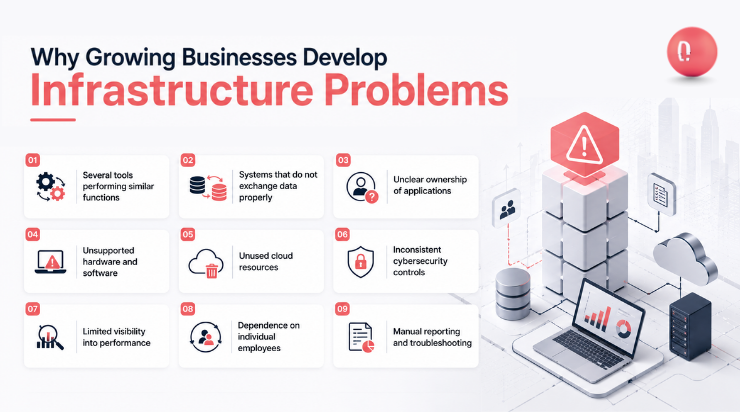
Why Growing Businesses Develop Infrastructure Problems
Technology environments often grow in response to immediate needs.
A new application is added for one department. Additional cloud storage is purchased for another team. A temporary remote-access solution becomes permanent. Different suppliers install systems without a shared architecture.
Each decision may solve a short-term problem. However, the combined environment can become difficult to manage.
Common results include:
- Several tools performing similar functions
- Systems that do not exchange data properly
- Unclear ownership of applications
- Unsupported hardware and software
- Unused cloud resources
- Inconsistent cybersecurity controls
- Limited visibility into performance
- Dependence on individual employees
- Manual reporting and troubleshooting
An infrastructure assessment brings these disconnected parts together and evaluates them as one business environment.
Signs Your Business Needs an Infrastructure Assessment
Frequent Performance Complaints
Slow applications, unstable internet connections and delayed file access may indicate network, storage or server-capacity problems.
Repeated complaints should not be treated as isolated user issues.
Recurring System Outages
When the same applications or devices continue to fail, the underlying architecture may require improvement.
Restarting equipment may restore service temporarily, but it does not solve the root cause.
Unexplained Cloud Spending
Cloud platforms make it easy to add resources.
They also make it easy to leave unused storage, inactive servers and oversized services running. Without proper governance, cloud spending can increase without delivering additional value.
DLAN’s cloud services include capacity planning, architecture reviews and cost optimisation.
Outdated Technology
Unsupported operating systems, applications and network equipment may no longer receive security updates.
They can also become incompatible with modern applications and services.
Limited Asset Visibility
Management should know which devices, systems, applications and cloud services the business owns or uses.
CISA states that continuous and comprehensive asset visibility is a basic requirement for effectively managing cybersecurity risk.
Heavy Dependence on Manual IT Support
When IT teams spend most of their time fixing recurring issues, they have less time for strategic improvements.
This can indicate weak monitoring, outdated systems or poor standardisation.
Security and Compliance Concerns
Unknown systems, excessive permissions, weak configurations and missing documentation can make audits and risk management more difficult.
An assessment can connect technology improvements with governance, risk and compliance requirements.
What an IT Infrastructure Assessment Should Cover
Asset Inventory
The assessment should identify the organisation’s hardware, software, cloud services, virtual systems and connected devices.
Important information may include:
- Asset owner
- Location
- Business purpose
- Current version
- Support status
- Security status
- Dependencies
- Replacement date
An accurate inventory helps the business identify unknown, duplicate and unsupported assets.
Network Architecture
The assessment should review how offices, remote users, cloud platforms, applications and data centres connect.
It may evaluate:
- Network diagrams
- Internet connections
- Wireless networks
- Firewalls
- Remote access
- Network segmentation
- Branch connectivity
- Traffic performance
- Redundancy
A poor network design can affect both productivity and security.

Servers, Storage and Data Centres
The review should check whether processing and storage capacity can meet current and expected demand.
It should also evaluate:
- Equipment age
- Resource utilisation
- Hardware support
- Power and cooling
- Physical security
- Redundancy
- Fault tolerance
- Expansion capacity
Organisations planning a major infrastructure upgrade may also require professional data-centre design and build consultancy.
Cloud Environment
Cloud assessments evaluate architecture, performance, cost, security and governance.
The review may identify:
- Unused resources
- Oversized systems
- Inconsistent configurations
- Weak access controls
- Missing backups
- Uncontrolled subscriptions
- Lack of cost ownership
- Poor integration with internal systems
Cybersecurity Controls
Technology performance and cybersecurity should not be assessed separately.
The review should include:
- Firewall configurations
- Endpoint protection
- Vulnerability management
- Security monitoring
- Identity and access control
- Multi-factor authentication
- Patch management
- Email security
- Data protection
- Incident-response readiness
DLAN’s cybersecurity services cover networks, applications, infrastructure, cloud systems, users and data.
Backup and Recovery
A backup is useful only when the organisation can restore its information.
An assessment should identify:
- Which systems are backed up
- How often backups run
- Where copies are stored
- Who receives failure alerts
- Whether backups are encrypted
- How often recovery is tested
- How long restoration may take
Application and Licence Review
Businesses may continue paying for applications that are no longer required.
An assessment can find:
- Duplicate tools
- Unused licences
- Unsupported applications
- Integration problems
- Manual workflows
- Expensive applications with limited value
IT Operations and Support
The assessment should also review how technology is managed.
This includes:
- Helpdesk processes
- Incident escalation
- Supplier responsibilities
- Change management
- System documentation
- Monitoring
- Maintenance schedules
- Service-level expectations
DLAN’s managed services support ongoing monitoring, infrastructure management, security operations and technical support.
What Should the Assessment Deliver?
A professional assessment should produce clear and practical outputs.
Current-State Overview
This explains the existing environment in language that both technical teams and business leaders can understand.
Risk Register
Risks should be recorded with their possible business impact, likelihood and recommended treatment.
Priority Matrix
Not every problem must be solved immediately.
Issues should be grouped into categories such as:
- Critical
- High priority
- Medium priority
- Long-term improvement
Quick-Win Recommendations
Some problems can be resolved quickly through configuration changes, licence removal, updated policies or improved monitoring.
Strategic Roadmap
The roadmap should explain which improvements should be completed first, which projects depend on other projects and what business outcome each improvement supports.
Budget Guidance
Decision-makers should understand the likely cost of maintaining, upgrading or replacing existing systems.
This supports better financial planning and prevents emergency purchases after a failure.
Business Benefits of an Infrastructure Assessment
Reduced Downtime
The assessment can identify single points of failure, capacity limitations and unsupported systems before they interrupt operations.
Better Technology Spending
The business can stop paying for unused licences, unnecessary cloud resources and duplicated tools.
Stronger Cybersecurity
Accurate asset information and infrastructure visibility help security teams identify vulnerable and unmanaged systems.
Improved Employee Productivity
Faster, more reliable applications allow employees to complete work without repeated technical interruptions.
Easier Growth
A scalable architecture makes it easier to add employees, offices, customers and applications.
Better Management Decisions
Leadership receives a clear view of technology risks, priorities and required investment.
When Should a Business Conduct an Assessment?
An infrastructure assessment is especially valuable before:
- Moving to the cloud
- Opening a new location
- Acquiring or merging with another business
- Replacing core applications
- Introducing remote work
- Preparing for an audit
- Expanding the workforce
- Building or upgrading a data centre
- Outsourcing IT operations
- Developing a digital-transformation strategy
It is also useful after repeated outages, security incidents or unexpected increases in technology spending.
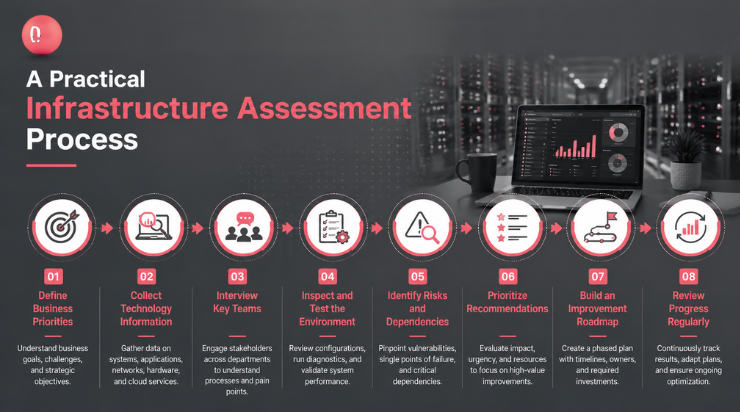
A Practical Infrastructure Assessment Process
1. Define Business Priorities
The assessment should begin with business goals, critical services and known operational concerns.
2. Collect Technology Information
Review documents, configurations, supplier agreements, licences, asset records and performance reports.
3. Interview Key Teams
Speak with management, IT staff, application owners and employees.
Technical records may show what exists, while employees explain how the systems perform in daily operations.
4. Inspect and Test the Environment
Review systems, networks, security controls, backups and capacity.
Testing should be planned carefully to avoid disrupting business operations.
5. Identify Risks and Dependencies
Determine which systems support critical business services and what other systems depend on them.
6. Prioritise Recommendations
Recommendations should be based on risk, business impact, cost and operational urgency.
7. Build an Improvement Roadmap
Create realistic phases with clear responsibilities, outcomes and performance measures.
8. Review Progress Regularly
The infrastructure environment continues to change.
New systems, users, cloud platforms and security risks should be included in future reviews.
How DLAN Supports Infrastructure Improvement
DLAN provides end-to-end technology support covering assessment, planning, implementation and ongoing management.
Depending on the organisation’s needs, DLAN can support:
- Infrastructure health assessments
- IT strategy development
- Network and system reviews
- Cloud architecture assessment
- Cloud cost optimisation
- Cybersecurity assessments
- Identity and access reviews
- Data-centre planning
- Capacity planning
- Technology roadmaps
- Risk and compliance alignment
- Managed monitoring and support
Through its wider IT and security services, DLAN helps organisations move from reactive technology support to structured, measurable infrastructure management.
Frequently Asked Questions
How long does an IT infrastructure assessment take?
The timeline depends on the size of the organisation, the number of locations and the complexity of its technology. A limited assessment may take a few days, while a multi-site enterprise review may require several weeks.
Is an infrastructure assessment the same as a cybersecurity audit?
No. A cybersecurity audit focuses mainly on security controls and compliance. An infrastructure assessment also evaluates performance, capacity, cost, architecture, reliability and support processes.
Will the assessment interrupt business operations?
Most information gathering and reviews can be completed without major disruption. Any testing that could affect production systems should be scheduled and approved in advance.
How often should infrastructure be assessed?
A detailed assessment may be conducted annually or before a major technology project. Critical assets, vulnerabilities, performance and capacity should be monitored more frequently.
Can an assessment help reduce IT costs?
Yes. It can identify unused licences, duplicate applications, inefficient cloud resources, ageing equipment and repeated support problems that increase operating costs.
Conclusion: Understand Your Infrastructure Before Making Your Next Investment
Technology decisions are difficult when the current environment is unclear.
An IT infrastructure assessment replaces assumptions with evidence. It shows where risks exist, which systems are limiting performance and where investment can deliver the greatest business value.
DLAN helps organisations assess infrastructure, define priorities and build secure, scalable technology roadmaps.
Contact DLAN to arrange an infrastructure review and identify the improvements your business should make next.
