








Why Telecom Projects Fail at Handover, Not Installation
A telecom site can appear complete while still being operationally unready. Equipment may be installed, power may be connected, cables may be routed, and initial testing may show acceptable results. However, the project can still face delays when documentation is incomplete, safety records are missing, test results are unclear, or the operations team does not have enough information to manage the site. Successful telecom project delivery should not be measured only by physical installation. A project is complete when the site has been properly designed, installed, tested, commissioned, documented, audited, accepted, and transferred to the team responsible for its operation. Professional Telecommunications services connect technical execution with quality assurance, safety, documentation, and long-term operational readiness.
Installation Is Only One Stage of Telecom Delivery
Telecom projects involve several technical and operational stages.
Depending on the project, these stages may include:
- Site surveys
- Design reviews
- Equipment planning
- Material coordination
- Electrical preparation
- Cellular rigging
- Equipment installation
- Cabling
- System configuration
- Network integration
- Testing
- Commissioning
- Safety inspection
- Quality verification
- Documentation
- Client acceptance
- Operational handover
When these stages are managed separately, important information can be lost between teams. The design team may not receive complete site information. Installation teams may make necessary field changes that are never added to the final drawings. Testing teams may identify issues without documenting how they were corrected. By the time the site reaches handover, the physical work may be complete, but the operational record may still be incomplete.
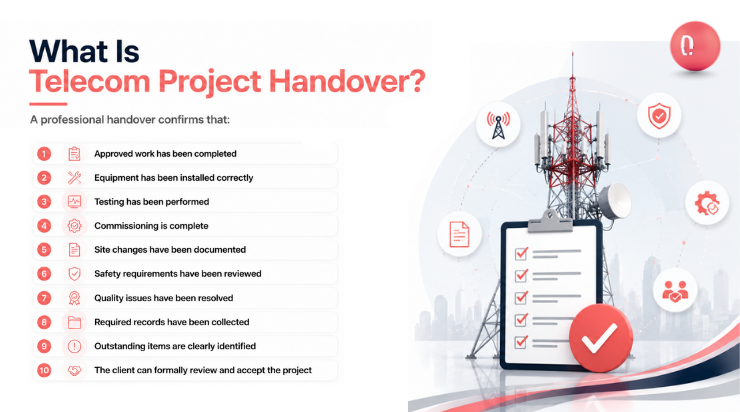
What Is Telecom Project Handover?
Telecom project handover is the formal transfer of a completed site or system from the project delivery team to the client, network operator, maintenance team, or another responsible stakeholder.
A professional handover confirms that:
- Approved work has been completed
- Equipment has been installed correctly
- Testing has been performed
- Commissioning is complete
- Site changes have been documented
- Safety requirements have been reviewed
- Quality issues have been resolved
- Required records have been collected
- Outstanding items are clearly identified
- The client can formally review and accept the project
Telecom handover should not be treated as a folder of documents created at the end of the project. It should be planned from the beginning and updated throughout the delivery lifecycle. Professional IT Consultancy services can also help organizations align telecom infrastructure with broader operational, connectivity, and technology requirements.
Why Telecom Projects Face Handover Delays
Incomplete Documentation
Installation teams may complete the physical work but fail to collect all required photographs, equipment details, serial numbers, test results, or configuration information. The team may then need to return to the site after the work has already been completed. This increases project costs and delays final acceptance.
Differences Between Design and Site Conditions
Telecom designs are prepared using information available before execution. During installation, teams may discover differences in:
- Equipment space
- Building structure
- Cable routes
- Power availability
- Existing infrastructure
- Access conditions
- Safety requirements
Field changes may be necessary, but those changes must be documented. If the final documentation still reflects the original design, future operations teams receive inaccurate information.
Unresolved Quality Issues
Small quality issues can prevent final acceptance.
Common examples include:
- Incorrect labels
- Poor cable management
- Loose fittings
- Incomplete sealing
- Missing protective components
- Unapproved material substitutions
- Weak grounding
- Incomplete testing
- Unclear photographs
- Unresolved inspection comments
A structured quality review identifies these problems before the client’s final inspection.
Weak Team Coordination
Telecom projects may involve designers, project managers, riggers, electrical technicians, network engineers, integration specialists, safety officers, quality auditors, suppliers, and client representatives. When responsibilities are unclear, important tasks may be assumed rather than formally assigned.
Late Documentation
When teams wait until the end of a project to prepare handover records, important information may already be unavailable. Technicians may have moved to another site, temporary notes may be lost, and photographs may not show the required detail. Documentation should be developed alongside physical project work.

The Role of DICI in Telecom Projects
DICI refers to Design, Installation, Commissioning, and Integration. These four stages form the technical foundation of telecom project delivery.
Design
The design stage translates business and network requirements into a practical site plan.
It may cover:
- Equipment placement
- Power requirements
- Cable routes
- Structural requirements
- Network connectivity
- Access requirements
- Safety requirements
- Capacity planning
- Integration needs
- Future expansion
A strong design reduces uncertainty during execution. However, approved field changes must be reflected in the final project records.
Installation
Installation converts the approved design into a physical telecom environment. This stage may include:
- Mounting equipment
- Installing racks
- Routing cables
- Connecting power
- Installing antennas
- Preparing network connections
- Applying labels
- Establishing grounding
- Implementing safety controls
Installation quality affects reliability, accessibility, maintenance, and future troubleshooting.
Commissioning
Commissioning confirms that installed equipment operates according to project requirements. it may include:
- Equipment startup
- Configuration review
- Power testing
- Connectivity testing
- Alarm checks
- Performance verification
- Fault identification
- Safety confirmation
- Test result documentation
Commissioning provides evidence that the site has moved from physical installation to operational readiness.
Integration
Integration connects the installed equipment with the wider network environment. A site may be powered and physically complete but still unable to provide the required service until it has been configured and integrated correctly. Telecom integration should be coordinated with security teams because network equipment, configurations, access credentials, and connected systems can introduce technical risks. Professional Cyber Security services can help protect telecom systems and associated digital infrastructure.
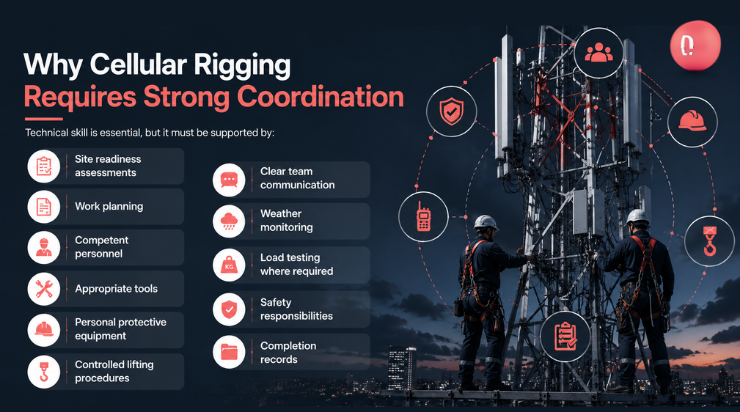
Why Cellular Rigging Requires Strong Coordination
Cellular rigging involves work at height, equipment handling, installation support, upgrades, relocation, and decommissioning.
Technical skill is essential, but it must be supported by:
- Site readiness assessments
- Work planning
- Competent personnel
- Appropriate tools
- Personal protective equipment
- Controlled lifting procedures
- Clear team communication
- Weather monitoring
- Load testing where required
- Safety responsibilities
- Completion records
Poor coordination during rigging can affect safety, equipment condition, structural integrity, and project schedules.
Rigging must therefore be connected with project management, quality reviews, safety auditing, and handover documentation.
The Importance of Telecom Electrical Work
Telecom equipment depends on stable and properly configured electrical infrastructure.
Electrical work may include:
- Power distribution
- Equipment connections
- Backup power systems
- Earthing and grounding
- Protection devices
- Cable installation
- Equipment configuration
- Testing
- Maintenance planning
A telecom site cannot be considered ready simply because the equipment powers on.
The electrical environment must support safe, stable, and maintainable operation.
Test records and final configurations should be included in the project handover.
What Is a Telecom Handover Pack?
A telecom handover pack, often called an HOP, is a structured collection of technical, operational, safety, and project records.
The exact requirements vary, but a handover pack may include:
- Approved designs
- As-built drawings
- Site photographs
- Equipment details
- Serial numbers
- Installation records
- Cable schedules
- Configuration information
- Commissioning results
- Test reports
- Quality inspection records
- Safety documents
- Approved change records
- Issue and resolution logs
- Outstanding items
- Maintenance information
- Stakeholder approvals
- Final acceptance records
A complete HOP creates continuity between the project delivery team and the teams responsible for network operation and maintenance.
Why Handover Packs Matter After Completion
Faster Troubleshooting
Maintenance teams can use drawings, equipment records, and configuration information to understand the site before beginning technical work.
Safer Maintenance
Safety documentation, electrical information, access requirements, and equipment locations help technicians prepare for future visits.
Clear Accountability
Approvals, tests, change logs, and completion records provide evidence of what was delivered and reviewed.
Organizations can strengthen this accountability by connecting telecom delivery with Governance, Risk and Compliance services.
More Efficient Upgrades
When the network requires expansion or equipment replacement, planners can use existing records rather than repeating the entire discovery process.
Knowledge Retention
Project knowledge should not remain only with the individuals who completed the site.
A complete HOP preserves essential information even when employees, vendors, or contractors change.
Quality, Health, and Safety Audits
Quality, health, and safety audits verify whether telecom project work meets technical, operational, and regulatory expectations.
A telecom audit may review:
- Workmanship
- Equipment installation
- Site safety
- Protective equipment
- Electrical conditions
- Access controls
- Documentation
- Labelling
- Testing
- Material use
- Environmental conditions
- Regulatory requirements
- Client specifications
Audits should not be treated as administrative obstacles.
They help identify problems while correction is still practical.
The Connection Between Telecom and Data Centers
Telecommunications infrastructure often supports data centers, server rooms, enterprise networks, and cloud connectivity.
Telecom planning may therefore overlap with Data Center Design and Consultancy, especially when projects depend on reliable power, network pathways, equipment environments, monitoring, and physical security.
Weak telecom infrastructure can affect data availability even when servers and applications are operating correctly.
What Makes a Telecom Handover Effective?
An effective handover should be:
Accurate
Documents must represent what was actually installed, not only what appeared in the original design.
Complete
All required photographs, tests, approvals, records, and evidence should be included.
Organized
Documents should follow an agreed naming structure and folder arrangement.
Traceable
Changes, equipment, approvals, issues, and test results should be easy to trace.
Reviewed
Information should be checked before submission rather than passed directly from field teams to the client.
Accessible
The responsible teams should know where records are stored and how they can access them.
Practical
Documentation should help teams operate, maintain, inspect, troubleshoot, and upgrade the site.
How to Improve Telecom Project Handover
Define Requirements Early
The project team should confirm required documents, tests, photographs, approvals, and formats before site work begins.
Assign Responsibilities
Every document and record should have a clear owner.
For example, rigging teams may provide specific completion photographs, while commissioning specialists provide test results and configuration information.
Use Standard Templates
Standard checklists and forms improve consistency across different sites and project teams.
Capture Evidence During Execution
Information should be collected while work is being performed rather than reconstructed later.
Maintain Change Control
Any change from the approved design should be recorded, reviewed, approved, and reflected in the final documentation.
Conduct Internal Reviews
The project team should inspect both the site and the handover pack before presenting them for client acceptance.
Track Outstanding Items
Unresolved issues should be listed with an owner, priority, deadline, and completion status.
Provide Knowledge Transfer
The receiving team should understand the site, major equipment, limitations, maintenance needs, and escalation procedures.
Ongoing Managed Services can then support monitoring, maintenance coordination, incident management, and long-term infrastructure operations.

Telecom Handover Across Different Sectors
Structured handover is especially important for enterprise technology environments where multiple locations, suppliers, systems, and operational teams depend on accurate technical information.
Telecom projects supporting government and strategic organizations may require formal documentation, stronger security controls, detailed approvals, and clear accountability.
Reliable telecommunications are also essential within the power and renewable energy sector, where communication systems may support remote sites, field teams, monitoring equipment, and critical infrastructure.
Frequently Asked Questions
What is telecom project handover?
Telecom project handover is the formal transfer of a completed telecom site or system from the delivery team to the client, operator, or maintenance team.
What does DICI mean?
DICI stands for Design, Installation, Commissioning, and Integration.
What should be included in a telecom handover pack?
A handover pack may include approved designs, as-built drawings, photographs, equipment records, commissioning results, test reports, safety documents, quality inspections, and acceptance records.
Why are as-built drawings important?
As-built drawings show the final installed condition of the site, including approved changes made during execution.
What causes telecom handover delays?
Common causes include missing documents, incomplete testing, unclear photographs, unresolved quality problems, inaccurate drawings, and missing approvals.
What is the purpose of a quality and safety audit?
A quality and safety audit reviews workmanship, site conditions, safety practices, project documentation, and compliance requirements before acceptance.
When should handover documentation be created?
Handover documentation should be developed throughout the project rather than prepared only after installation is complete.
Conclusion
A telecom project is not complete when equipment has only been installed and powered on. True project completion requires testing, commissioning, integration, safety verification, quality review, accurate documentation, client acceptance, and knowledge transfer. A structured telecom project handover reduces delays, supports safer maintenance, improves future troubleshooting, and preserves important technical information. Complete HOPs, updated as-built drawings, commissioning results, equipment records, safety documentation, and issue logs give operators the information they need to manage the site confidently. DLAN delivers end-to-end telecom project support that connects physical execution with project management, quality assurance, safety auditing, documentation, and final handover. Planning a telecom installation, upgrade, relocation, commissioning, or handover project? Contact DLAN to discuss a complete telecom delivery solution focused on quality, safety, operational readiness, and long-term reliability.
