







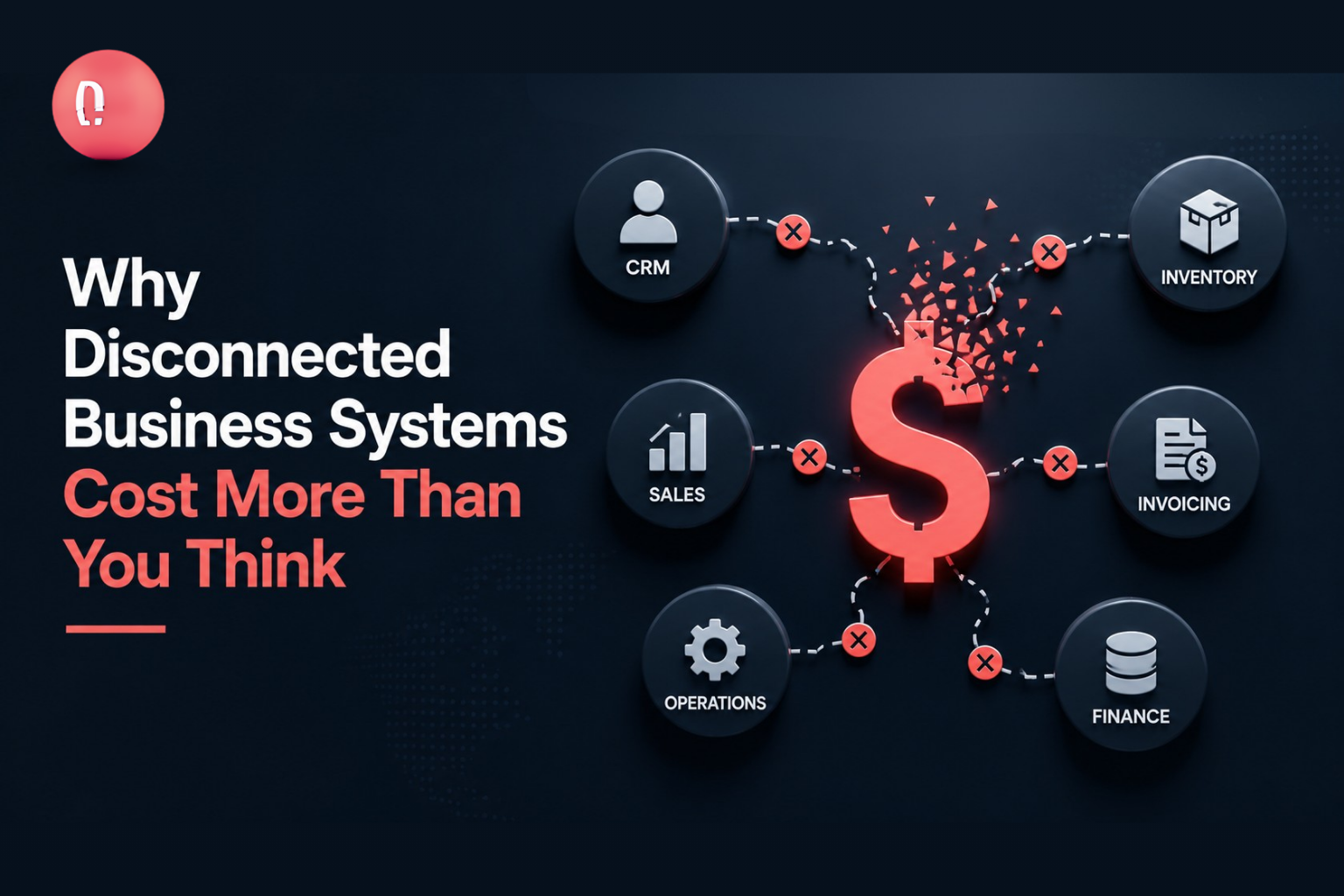
Why Disconnected Business Systems Cost More Than You Think
Modern businesses rely on multiple digital platforms to manage customers, sales, finance, employees, inventory, communication, and reporting.
A company may use one platform for customer relationship management, another for accounting, and separate applications for inventory, marketing, customer support, and internal collaboration.
Each system may perform its individual function well. However, problems begin when these systems cannot communicate with each other.
Employees must then copy information between applications, update the same records several times, export spreadsheets, and manually verify data across different departments.
These disconnected processes increase operational costs, create errors, delay decision-making, and reduce employee productivity.
Professional Software Solutions can help businesses connect applications, automate workflows, and create a more coordinated digital environment.
What Are Disconnected Business Systems?
Disconnected business systems are applications, databases, or platforms that operate independently, even when they support related business processes.
For example, a sales employee may add customer information to a CRM, but the finance department may still need to enter the same information into an accounting system.
Similarly, an order placed through an e-commerce website may not automatically update inventory. An employee must review the transaction and manually adjust stock levels.
This problem often develops gradually.
Different departments purchase software based on their own immediate requirements without considering how those applications will connect with the rest of the organization.
Over time, the business ends up with several useful platforms that do not form one coordinated technology environment.
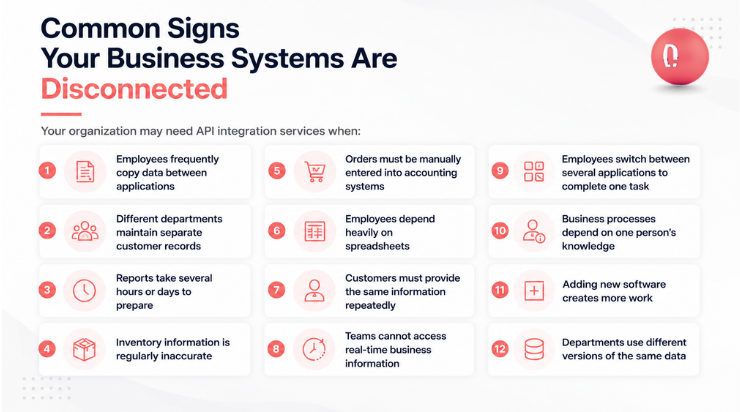
Common Signs Your Business Systems Are Disconnected
Your organization may need API integration services when:
- Employees frequently copy data between applications
- Different departments maintain separate customer records
- Reports take several hours or days to prepare
- Inventory information is regularly inaccurate
- Orders must be manually entered into accounting systems
- Employees depend heavily on spreadsheets
- Customers must provide the same information repeatedly
- Teams cannot access real-time business information
- Employees switch between several applications to complete one task
- Business processes depend on one person’s knowledge
- Adding new software creates more work
- Departments use different versions of the same data
These problems are not always caused by poor software. They are often caused by weak connections between otherwise useful systems.
The Hidden Cost of Disconnected Software
The cost of disconnected systems goes beyond software subscriptions.
It affects productivity, reporting, customer service, security, and the organization’s ability to grow.
Repetitive Manual Work
When systems cannot exchange information, employees become responsible for moving data manually.
A customer record may need to be entered into a CRM, finance platform, support system, and reporting spreadsheet.
Every additional entry takes time that employees could spend on customer service, sales, planning, or other valuable activities.
A professional IT Consultancy assessment can help identify repetitive workflows, technical limitations, and opportunities for automation.
Data Entry Errors
Manual data transfer increases the possibility of incorrect names, duplicated records, missing orders, inaccurate prices, and outdated customer information.
Even a small mistake can affect invoicing, deliveries, stock management, reporting, or customer communication.
When platforms are connected, approved information can move automatically between systems, reducing the need for repeated data entry.
Delayed Business Decisions
Business leaders need accurate and current information.
When data is spread across different platforms, teams must collect, compare, and combine it before creating reports.
By the time the report is completed, the information may already be outdated.
Connected systems can provide leadership teams with more timely information about sales, expenses, customers, operations, and performance.
Poor Customer Experience
Disconnected platforms can make customers repeat information or wait longer for updates.
A customer may place an order but receive no delivery update because the sales and logistics systems are not connected.
Similarly, a support representative may not be able to view the customer’s purchase history without contacting another department.
System integration helps customer-facing teams access relevant information more quickly.
Limited Scalability
Manual processes may work when a company has a small number of customers or transactions.
As the business grows, the same processes become difficult to manage. More employees are required simply to transfer data and maintain records.
Instead of supporting growth, the technology environment begins to slow the business down.
What Are API Integration Services?
An application programming interface, commonly called an API, allows different software systems to exchange information and perform approved actions.
API integration services involve designing, developing, securing, testing, and maintaining these connections.
For example, an API integration can automatically send customer information from a website to a CRM.
The CRM can then share approved order information with an accounting system, while the inventory platform updates available stock.
This process happens without employees entering the same information repeatedly.
Which Business Systems Can Be Integrated?
API integrations can connect many different types of platforms, including:
- Customer relationship management systems
- Enterprise resource planning software
- Accounting and billing platforms
- E-commerce websites
- Inventory management systems
- Human resource applications
- Customer support platforms
- Marketing automation software
- Payment gateways
- Logistics and delivery systems
- Business intelligence dashboards
- Internal databases
- Mobile applications
- Supplier platforms
- Cloud applications
Businesses increasingly depend on online platforms, making properly managed Cloud Services an important part of scalable application integration.
The objective is not to connect every available application.
The goal is to connect the systems where shared data and automation can create measurable operational value.
How System Integration Improves Business Operations
A Consistent Source of Information
Integration reduces the number of separate records maintained by different departments.
When customer, inventory, sales, or financial information is updated in one approved system, the relevant change can be shared with other connected platforms.
This creates more consistent and reliable data across the business.
Faster Workflows
Connected systems can automatically trigger the next stage of a process.
For example:
- A customer submits an online order.
- The payment is verified.
- Inventory is updated.
- The warehouse receives the order.
- The customer receives confirmation.
- The transaction is recorded for reporting.
Without integration, employees may need to complete several of these steps manually.
Improved Reporting
Integration allows information from sales, finance, customer support, inventory, and marketing platforms to be combined more efficiently.
Leadership teams can access centralized dashboards rather than requesting separate reports from each department.
This provides a clearer view of overall business performance.
Better Customer Service
Connected systems allow customer service representatives to access purchase history, payment status, delivery updates, previous communication, and support requests from one place.
This enables faster and more accurate responses.
Stronger Security Controls
Integrating systems can also improve visibility into how sensitive information moves through the organization.
However, APIs must be protected through authentication, encryption, permission management, input validation, monitoring, and secure credential storage.
Professional Cyber Security services can help businesses protect APIs, application access, user identities, and sensitive information.
API Integration Versus Custom Software Development
Not every business problem requires a completely new platform.
In many cases, existing applications already provide the required functions. They simply need to exchange information more effectively.
API integration may be suitable when:
- Existing applications are still useful
- Employees repeatedly transfer data manually
- Several departments use different platforms
- New software must connect with older systems
- The company wants gradual digital transformation
- Replacing every system would be too costly or disruptive
Custom software may be more suitable when:
- Existing applications cannot support a unique workflow
- The business depends on complex manual processes
- Available platforms have significant limitations
- The organization needs greater control over functionality
- A specialized employee or customer platform is required
A combination of custom software development and API integration often provides the most practical solution.

How to Plan a Successful Integration Project
Map Existing Workflows
Before selecting technology, document how information currently moves through the business.
Identify where data is created, where it is copied, which departments use it, and where delays frequently occur.
This prevents the organization from automating an inefficient process without improving it.
Select High-Value Integrations
Start with connections that address clear business problems.
Examples include:
- Website leads connected with the CRM
- CRM records connected with finance
- Online orders connected with inventory
- Inventory connected with supplier systems
- Customer support connected with purchase history
- Sales information connected with reporting dashboards
A phased approach reduces risk and allows the business to measure results.
Review API Availability
Some applications provide well-documented APIs, while others have limited integration capabilities.
Older platforms may require middleware, database connections, or a custom integration layer.
A technical assessment is necessary before selecting the integration method.
Define Data Ownership
The organization should decide which system is responsible for maintaining each type of information.
For example, the CRM may be the primary source for customer records, while the finance platform remains responsible for payment data.
Without clear ownership, integrations can create conflicting or duplicated records.
Build Security into the Project
API integration may involve customer, employee, financial, or operational information.
Important security controls include:
- Authentication
- Authorization
- Encryption
- Access restrictions
- Activity logging
- Rate limiting
- Input validation
- Secure credential storage
- Error monitoring
- Regular security reviews
Organizations handling regulated information should also connect integration projects with appropriate Governance, Risk and Compliance services.
Test Real Business Scenarios
Testing should cover more than successful data transfers.
The integration team should test:
- Duplicate records
- Missing information
- Incorrect formats
- Failed transactions
- Unauthorized requests
- Unavailable applications
- High transaction volumes
- Delayed responses
- System recovery
This helps prevent technical errors from affecting customers or daily operations.
Monitor the Integration
APIs and connected applications can change over time.
Software providers may modify authentication requirements, data fields, usage limits, or available functionality.
Ongoing Managed Services can support integration monitoring, maintenance, incident resolution, and performance optimization.
System Integration Across Different Industries
Integration requirements vary depending on the organization’s size, industry, and operating model.
Large organizations may need integration across multiple departments, locations, suppliers, and internal platforms. Connected systems are especially important for enterprise technology environments where accurate data must move between many business functions.
Within healthcare, secure healthcare IT solutions can connect patient administration, clinical workflows, billing, reporting, and communication systems.
Financial organizations may require secure integration across transactions, customer records, compliance tools, reporting platforms, and risk systems. DLAN supports technology requirements for complex banking environments where security, accuracy, and availability are essential.
Frequently Asked Questions
What are API integration services?
API integration services connect two or more software applications so they can securely exchange data and complete approved actions automatically.
Can API integration connect legacy software?
Yes. Older systems may be connected through APIs, middleware, database integration, or custom integration layers. A technical assessment is required to determine the best method.
Is API integration secure?
API integration can be secure when authentication, encryption, access controls, monitoring, validation, and secure credential management are implemented properly.
Does a business need to replace its existing software?
Not necessarily. Integration often allows businesses to keep useful existing systems while improving how information moves between them.
What happens when a connected system becomes unavailable?
A well-designed integration should include error handling, transaction logs, alerts, retry processes, and recovery procedures.
Can several applications be connected?
Yes. A centralized integration layer can connect multiple systems while controlling how information is shared between them.
Conclusion
Using more software does not automatically make a business more efficient.
When systems remain disconnected, employees spend valuable time transferring information, correcting errors, preparing reports, and coordinating processes between departments.
API integration services transform separate applications into a connected digital environment.
By integrating CRM, finance, inventory, e-commerce, support, and cloud platforms, businesses can automate workflows, improve data accuracy, strengthen reporting, and create a better customer experience.
DLAN develops secure, scalable, and business-focused integrations designed around existing systems and operational goals.
Ready to eliminate manual data entry and disconnected workflows? Contact DLAN to discuss a secure API integration and software modernization strategy for your organization.
