







Managed IT Services: How Proactive Technology Support Helps Businesses Stay Secure and Productive
Technology is now part of every business function. Teams use digital tools to communicate, manage customers, process payments, store files, run reports, protect data, and deliver services. When technology works well, employees stay productive and customers receive better service. When it fails, the entire business slows down.
For many companies, IT problems are handled only when something breaks. A system goes down, an employee cannot access a tool, a device stops working, or a security alert appears. The team then rushes to fix the issue. This reactive approach may work for very small setups, but it becomes risky as the business grows.
Managed IT services give businesses a better way to run technology. Instead of waiting for problems, managed services focus on monitoring, maintenance, support, security, and continuous improvement. The goal is simple: keep systems stable, secure, and ready for business growth.
For growing companies, managed IT services are not just a technical convenience. They are a business strategy. They help reduce downtime, improve cybersecurity, control costs, support employees, and give leadership more confidence in daily operations.
What Are Managed IT Services?
Managed IT services involve outsourcing the management and support of business technology to a specialist provider. These services can include helpdesk support, network monitoring, cybersecurity management, cloud support, backup management, patching, endpoint protection, server maintenance, user access management, and IT reporting.
Instead of hiring separate experts for every technical area, businesses can work with a managed service provider that acts as an extension of their internal team. This gives the organization access to skilled support without the cost and complexity of building a large in-house IT department.
Managed services can support small businesses, mid-sized companies, and enterprise environments. The service model can be adjusted based on the size, risk level, industry, and technology needs of the organization.
Why Reactive IT Support Creates Problems
Reactive support means waiting until something goes wrong before taking action. This can create repeated interruptions and hidden costs.
For example, if software updates are delayed, systems may become vulnerable. If backups are not monitored, the business may not discover a failure until recovery is needed. If devices are not managed properly, employees may face slow performance and security gaps. If network issues are not detected early, the business may suffer downtime during critical hours.
Reactive IT also puts pressure on internal teams. Employees may spend time reporting issues, waiting for fixes, and finding temporary workarounds. Managers may lose visibility into recurring problems because the focus stays on quick fixes instead of root causes.
Managed IT services shift the approach from reaction to prevention.
The Proactive Advantage
Proactive IT support means systems are continuously monitored and maintained. Problems are identified early. Updates are managed properly. Security risks are reviewed before they become serious. Support requests are tracked and resolved with structure.
This approach helps businesses stay ahead of issues. It also creates a more stable work environment for employees.
A proactive managed service model usually includes regular health checks, performance monitoring, security alerts, vulnerability management, software patching, backup verification, access reviews, and reporting.
The result is fewer surprises, faster response, and better control over technology.
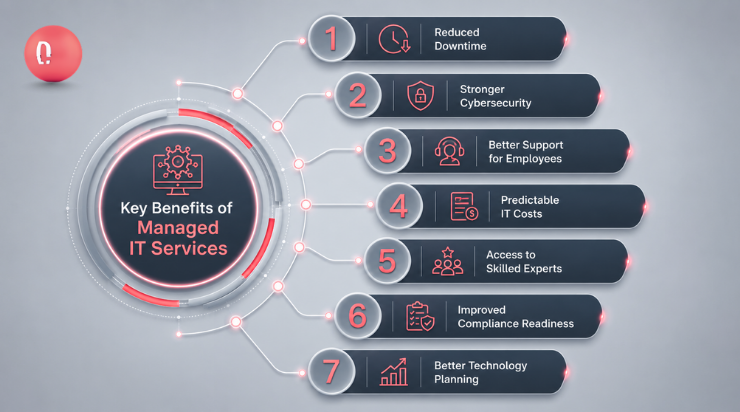
Key Benefits of Managed IT Services
1. Reduced Downtime
Downtime affects productivity, customer experience, and revenue. Even a short outage can delay work, stop communication, or interrupt service delivery.
Managed IT services help reduce downtime through monitoring, maintenance, redundancy planning, and faster response. When systems are being watched continuously, warning signs can be detected before they turn into major problems.
For example, storage capacity issues, server performance problems, network instability, and backup failures can often be identified early. This gives the team time to act before users are affected.
2. Stronger Cybersecurity
Cybersecurity threats are growing more advanced. Businesses face phishing, malware, ransomware, credential theft, insider mistakes, cloud misconfigurations, and device-level risks.
Managed IT services improve cybersecurity by adding structured protection across users, devices, networks, and cloud environments. This may include endpoint security, firewall monitoring, identity access control, vulnerability scanning, patch management, threat detection, incident response, and security awareness support.
A managed service provider can also help businesses identify weak points and prioritize improvements. This is especially useful for companies that do not have a dedicated cybersecurity team.
3. Better Support for Employees
Employees need technology to do their jobs. When they face repeated technical issues, productivity drops and frustration increases.
Managed IT services provide structured support for everyday problems such as login issues, software errors, device troubleshooting, email problems, connectivity issues, and access requests.
A good support process improves employee experience. Instead of depending on informal help or delayed responses, employees get clearer communication and faster resolution.
This helps teams stay focused on their real work.
4. Predictable IT Costs
Technology costs can become unpredictable when businesses operate without proper planning. Emergency fixes, unexpected hardware failure, security incidents, and urgent consultant fees can create financial pressure.
Managed IT services provide a more predictable cost model. Businesses can plan monthly or yearly support costs and reduce the chances of expensive emergency work.
This does not mean every cost disappears. But it does mean technology spending becomes more controlled and better aligned with business priorities.
5. Access to Skilled Experts
Modern IT requires many skills. A business may need knowledge of cloud platforms, cybersecurity, networking, servers, endpoint devices, compliance, backup systems, and business applications.
Hiring experts for all these areas can be difficult and costly. Managed IT services give businesses access to a wider technical skill set without needing to hire every role internally.
This is valuable for growing companies that need expert support but also need to control overhead.
6. Improved Compliance Readiness
Many businesses need to follow industry standards, customer requirements, or internal audit controls. Even if the company is not heavily regulated, basic IT documentation, security policies, access control, and backup processes are important.
Managed IT services help improve compliance readiness by maintaining records, monitoring systems, applying security controls, and supporting audits.
This can include access logs, patch records, incident reports, asset inventories, backup reports, and security documentation.
7. Better Technology Planning
Managed IT services are not only about support. They also help businesses plan ahead.
A managed service provider can review current systems, identify outdated tools, recommend upgrades, plan migrations, improve security posture, and create technology roadmaps.
This helps leadership make better decisions. Instead of investing randomly in tools, the business can choose solutions that match its goals, budget, and future growth.
Managed IT Services and Cybersecurity
Managed IT and cybersecurity should work together. A stable IT environment is also a safer environment. When devices are updated, access is controlled, backups are verified, and networks are monitored, the business becomes harder to attack.
Managed security services may include 24/7 monitoring, managed detection and response, vulnerability management, SIEM monitoring, threat intelligence, and incident response.
This is important because many attacks begin with simple weaknesses: an unpatched system, a reused password, a misconfigured cloud account, or a phishing email. Proactive IT management helps reduce these risks.
Managed IT Services and Cloud Operations
Many businesses now depend on cloud applications, remote access tools, SaaS platforms, and hybrid infrastructure. These systems need regular management to remain secure, cost-effective, and reliable.
A managed service model can support cloud services by monitoring usage, managing access, improving security, reviewing costs, and helping teams avoid configuration mistakes.
Cloud environments are flexible, but they are not automatically optimized. Without proper management, businesses may face cost overruns, access risks, poor visibility, and performance issues. Managed support helps keep cloud operations under control.
When Should a Business Consider Managed IT Services?
A business should consider managed IT services when technical issues happen frequently, internal teams are overloaded, cybersecurity risks are increasing, systems are becoming harder to manage, or leadership wants more predictable IT costs.
Other signs include slow response times, poor documentation, repeated downtime, unclear backup status, outdated equipment, unmanaged devices, or lack of visibility into security risks.
Managed services are also useful when a company is expanding to new locations, hiring more employees, adopting cloud systems, or preparing for compliance requirements.
The best time to start is before problems become serious. Early support is usually less expensive than emergency recovery.
How Managed Services Support Business Growth
As a business grows, its technology environment becomes more complex. New users need access. New applications need support. More data needs protection. Remote teams need secure connectivity. Customers expect reliable digital services.
Managed IT services help businesses grow without losing control. They create structure around support, monitoring, security, and planning. This makes growth smoother and less risky.
Instead of constantly solving urgent problems, the business can focus on improving processes, serving customers, and scaling operations.
Managed Services for Enterprise Environments
Large organizations need reliable systems across departments, locations, users, and business functions. For enterprise teams, managed services provide structure, accountability, and technical visibility.
Enterprise environments often include multiple networks, applications, cloud platforms, devices, and access levels. Without centralized monitoring and support, small issues can become widespread operational problems.
Managed services help enterprise teams maintain better control, reduce downtime, and improve overall technology performance.
Managed Services for Healthcare and Banking
Different industries need different support models. For healthcare organizations, technology support must protect sensitive records, support system availability, and help clinical or administrative teams work smoothly.
For banking, managed services must support secure access, transaction reliability, compliance readiness, and strong operational monitoring.
Both industries need more than basic IT troubleshooting. They need proactive support, risk visibility, security management, and documentation.
Managed Services and Governance
Managed services also help businesses strengthen governance risk and compliance. This includes access reviews, asset documentation, incident records, security reporting, policy support, and audit readiness.
When IT operations are managed properly, leadership has a clearer view of risk. Teams can understand which systems are protected, which issues need attention, and which controls are active.
This makes governance practical instead of theoretical.
Managed Services and Infrastructure Readiness
Managed IT support works best when infrastructure is stable and properly designed. A business with poor cabling, weak power planning, outdated servers, or unclear documentation will face repeated support problems.
That is why managed services often connect with data center consultancy. A strong infrastructure foundation makes monitoring, maintenance, and security much easier.
When the data center is ready, managed services become more effective. Teams can detect issues faster, respond with better context, and plan upgrades with more confidence.
Connectivity and Telecommunications Support
Managed operations also depend on reliable connectivity. Branch offices, remote users, cloud systems, and customer-facing applications all need stable network communication.
A managed services strategy should consider telecommunications requirements such as bandwidth, redundancy, network performance, and site connectivity.
If connectivity is weak, users may experience slow systems even when applications and devices are working correctly. Strong telecom planning improves the full managed IT experience.

Software Support and Business Applications
Managed services also support the tools employees use every day. Business applications, custom platforms, customer portals, and reporting systems need stable environments to perform well.
When companies invest in software solutions, they also need support for hosting, access, security, updates, integrations, and user issues.
This connection between software and managed support helps businesses get more value from their digital systems.
Choosing the Right Managed Services Partner
The right partner should understand both technology and business goals. They should provide clear communication, structured support, security awareness, transparent reporting, and scalable services.
Businesses should look for a provider that can support current needs but also help with future planning. A strong partner should be proactive, responsive, and experienced across infrastructure, cybersecurity, cloud, and operational support.
The relationship should feel like an extension of the business, not just an external helpdesk.
Final Thoughts
Managed IT services help businesses move from reactive fixes to proactive technology management. They improve uptime, strengthen cybersecurity, support employees, control costs, and create a more stable foundation for growth.
In a digital business environment, technology cannot be left unmanaged. Every system, device, user, and connection matters. With the right managed services model, businesses can reduce risk and operate with greater confidence.
DLAN provides managed services designed to help organizations maintain secure, efficient, and high-performing digital environments. With proactive monitoring, expert support, cybersecurity focus, and scalable service delivery, businesses can focus on growth while their technology stays protected and reliable.
